
Whenever I present TrueX as an Enterprise AI Platform, the same question comes back: what exactly is an ‘Enterprise AI Platform’? Given how fast Generative AI is moving, with new capabilities appearing almost daily, that is a fair question. So let’s get behind the jargon. The quickest way to do that is a short tour through how systems, solutions and platforms in this space have developed.
Three ways Generative AI is used today
Generative AI is shorthand for Large Multimodal Models – language (LLMs), vision and audio – and what they can do. Usage currently falls into three main strands:
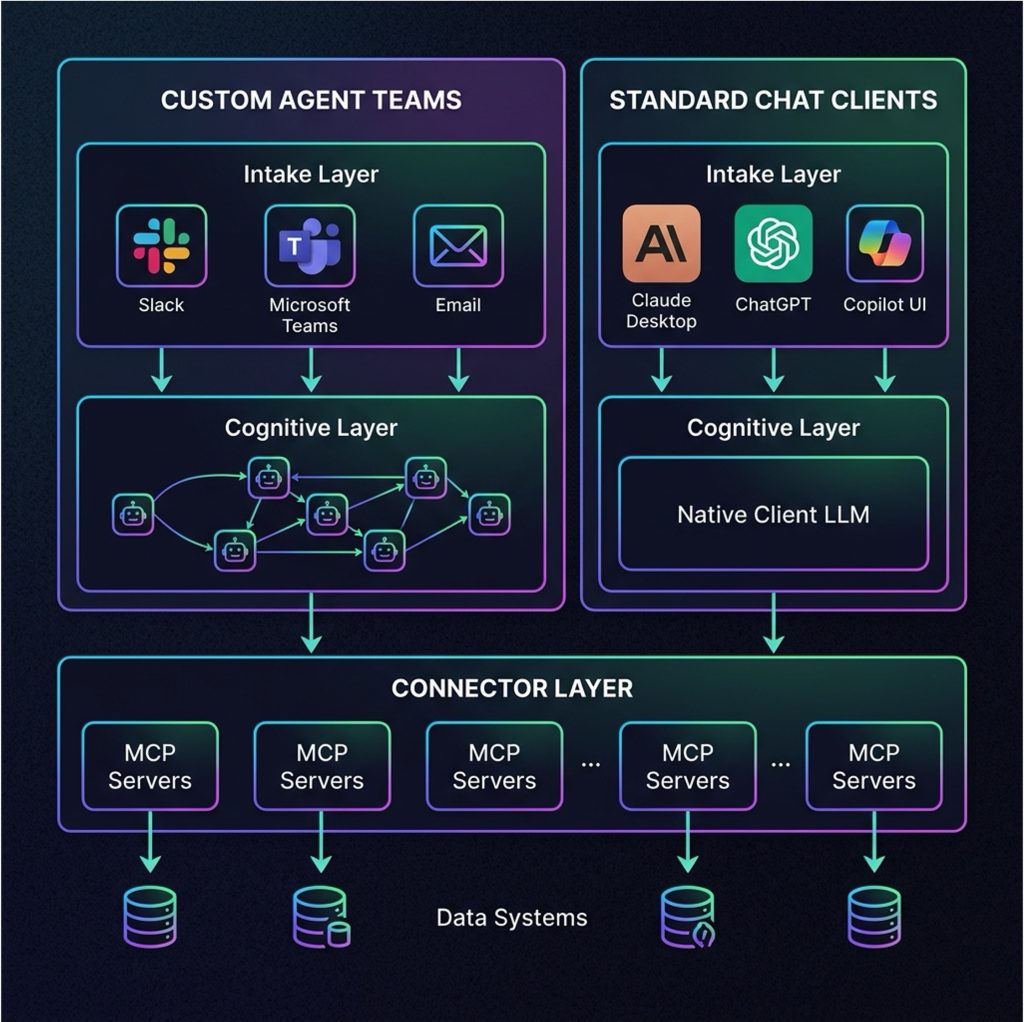
- Direct use through a chat interface. Users discover, analyse, improve and present knowledge: web search, document review and drafting, ‘how-to’ advice. These interfaces were first offered by the big model providers – OpenAI (ChatGPT), then Anthropic (Claude), Google (Gemini) and others – and later by independent chat-interface providers such as LM Studio.
- Using the model’s API to drive AI Agents and robots. To keep this article focused, we will concentrate on agents that drive business optimisation and automation, and on coding.
- Building AI Agents in code. Traditionally, agents that automate or improve business activities have been built by developers using the ReAct pattern of agentic reasoning, with libraries and frameworks such as LangGraph, AutoGen and PydanticAI, mostly in Python or Node.js.
Agents need tools
An agent built this way can reason, but it cannot do anything useful until it is given tools to interact with its environment:
- Execute web searches
- Access company knowledge held in documents (RAG)
- Access enterprise systems and databases
With tools, agents can gather the information that guides their reasoning and turn their decisions into business results – answering employees or customers, updating databases and systems, and so on.
It was soon discovered that, with the right training plus RAG and tools, agents could also act as programmers, producing designs and code from prompts and user ideas in most known programming languages. That opened a further possibility: rather than coding every tool in advance, an agent could be instructed to create the tools it needed ‘on the fly’ – for a new API, or for parts of a known API that existing tools did not cover. Or, even better, create agents ‘on the fly’ and related prompts, to use the tools and act.
The problem with direct tool access
Giving LLMs direct access to tools turned out to be far from optimal. Calling a program means knowing exactly what data it expects, what type each parameter is (number, string, Boolean and so on) and in what order to supply them. Programs need structured inputs and return structured outputs, today most commonly in JSON. All of that had to be described to the LLM in natural language so it could build the right JSON to call the tool.
Invariably, LLMs got confused or ‘hallucinated’: producing calls that could not execute, passing wrong data or – worse – misinterpreting the data and taking the wrong action. Tools created on the fly made this more dangerous still, as a hallucination could produce a tool that deleted data it should never have touched.
The MCP protocol was created to solve this: an intelligent, AI-aware API layer sitting between tools and LLMs that addresses every issue above – with the exception, perhaps, of on-the-fly tool creation (more on that later).
Chat interfaces become platforms
Meanwhile, chat interfaces (strand 1 above) evolved in parallel and started leveraging agentic AI. Behind the scenes, users were given agents that would build whatever tools were needed to complete a request – reading a document, searching the web, manipulating information – and in many cases those interfaces would spin up new agents on the fly to do it. More recently, users have been able to add MCP servers to their chat interface to extend the LLM’s capabilities.
These developments turned what began as a simple interface for casual interaction with an LLM into a ‘platform’. Not to be outdone, the big cloud providers (AWS and Google, for example) launched platforms of their own, focused on making it easier to build agents and agentic flows with less coding.
The gaps that remain
The direction of travel is clear: platforms that make GenAI easier to use every day. But real gaps remain:
- Coding, or no control. On cloud platforms users still have to code their agents; in chat interfaces they have no control over how agents are created. The former means slow adoption – even with AI assistance it needs specialist skills to do well, and is usually done in languages such as Python that were not designed for security or scale. The latter means expensive LLM tokens are burned again and again creating agents on the fly. Either way: high cost through token consumption for coding on the fly, slow execution.
- Two audiences, two worlds. Cloud platforms are the remit of the IT team; business users prefer the familiar chat interface.
- Weak or expensive security, scalability and observability for the resulting agentic environment, beyond whatever the core chat interface or cloud platform provides. It is not easy to monitor and cost-bound ‘on the fly’ agent and tool creation.
- Capabilities are personal, not enterprise. Agentic flows and the automation they produce are tied to the individual chat-interface user and are not easily deployed across the organisation.
- Locked into a specific provider’s LLM. Using Anthropic’s, or OpenAI’s ChatGPT interface, you are locked to those provider’s models (and resulting costs and capabilities)
- No corporate MCP store. Maintaining approved MCP servers, controlling their deployment and mandating certain servers enterprise-wide is weak to near-impossible with current chat interfaces. Bespoke MCP servers are usually hosted locally, and their adoption in a corporate context is fraught with security, observability and manageability issues.
Addressing these gaps is what has driven the development of Enterprise AI Platforms – and, in our case, TrueX.
What an Enterprise AI Platform lets you do
With an Enterprise AI Platform such as TrueX, companies can:
- Create and deploy MCP servers fast, from templates and interface definitions – Swagger, DDL, even Excel spreadsheets – or build bespoke servers and bring them in quickly and securely (in TrueX’s case in Rust, currently one of the fastest and most secure languages available). Either way, the platform hosts the servers centrally, catalogues them and makes them available to authorised users.
- Put guardrails around MCP server code-mode, which creates tools on the fly for API calls that have not been pre-coded. The guardrails stop harmful, hallucination-generated tools from executing and causing damage such as deleting data.
- Create agents – or teams of agents for complex, multi-step processes – without writing code. Agents are given access to the relevant MCP servers and approved LLMs by on-screen selection. This confines coding to the MCP server (connector) layer and makes the agents available to everyone in the enterprise who is authorised to use them. This simplicity almost completely eliminates the need for ‘on the fly’ agent creation, for business flow execution.
- Integrate those agents into the company’s secure communication channels – email, Teams, Slack – so that interaction with users, customers and suppliers is seamless and human-like.
- Use any AI Model and model provider, even self hosted ones, simply – with the flexibility of enabling different LLMs for different agents even in the same flow, or changing an LLM for an agent at the click of a button.
- Evaluate the resulting AI solution for accuracy against the intended business outcomes, cost, speed and security, using ground-truth data where appropriate and modern methods such as LLM-as-a-Judge.
- Secure everything end to end, by plugging the automation into the company’s existing authorisation and RBAC services.
In a nutshell
Companies use an Enterprise AI Platform to:
- Build MCP servers that employees can use securely from their familiar AI chat interface (ChatGPT and the like) to find corporate information and get the distilled advice they need to make winning decisions fast.
- Deploy complex agentic automation that uses those MCP servers and integrates with existing communication channels, so users, customers, partners and suppliers can adopt it seamlessly with minimal effort or change to existing processes. Without any AI Model provider lock-in.
- Make sure everything is as accurate, efficient and secure as expected.
Cost, and what happens after deployment
Given these capabilities, the resulting solution is bound to be token-efficient. Agents are prompt-tuned for efficient execution (and constrained to avoid token-cost shock), there is no ad-hoc agent creation, and the situations in which an MCP server needs to ‘burn’ tokens generating on-demand code are limited to the few not already covered by tools.
Once the solution is built and deployed, the platform is then used to observe, monitor, improve and expand it. That observability should be end to end, bringing together performance, cost and security from the infrastructure all the way to LLM interactions and channel information flow.
The emerging market
Alongside TrueX, a handful of other Enterprise AI Platforms are now appearing. We were early to make GenAI-focused evaluation a core part of the platform, and we remain one of very few that can not only provide all the MCP and Agentic capabilities outlined above securely, scale-ably and observably; but also be able to evaluate any agent or model – ours, third-party or self-hosted – against ground truth, on a schedule, as a standard component of the platform.